Basics


Info Download

Advanced

v/v
V
V

Plot Download

: Discussing siblings, parents, and simple physical needs like hunger or thirst.

If you cannot legally obtain the original audio, do not abandon listening assessment. You can create your own audio using modern tools:

Typically distributed as audio files (MP3 format in modern editions, or CDs in older printings), the audio is easy to integrate into a classroom setting via laptop, Bluetooth speaker, or language lab system. The tracks are usually indexed clearly, making it easy to find the correct test section during exam time.

The audio is a tapestry of mundane, wonderful life. Track 2 presents a man talking about his morning routine. “I wake up at seven o’clock. I have a shower. Then I eat toast.” The sentences are short, fortified with only the most essential verbs and nouns.

| Problem | Likely Cause | Solution | | :--- | :--- | :--- | | | Media player doesn’t support MP3 codec. | Use VLC Media Player (free) instead of Windows Media Player. | | Audio is too fast/slow | Sample rate mismatch (44.1kHz vs 48kHz). | Convert the MP3 to WAV using Audacity (free software). | | Missing Track 5 | Corrupted download from a file-sharing site. | Redownload only from Oxford Premium. | | Accent is unintelligible | Students are struggling with standard British English (RP). | Pause after the first play; explain key dialect differences. | | Cannot find File 7 Test | Mismatched edition (First vs Second vs Third). | Check your booklet cover for "Second Edition" – audio tracks are not cross-compatible. |
Disclaimer: This tool is provided for educational and illustrative purposes only. No guarantee is made regarding accuracy, suitability, or performance. Use at your own risk. - Copyright: ufelectronics.eu / Andreas Dyhrberg

×
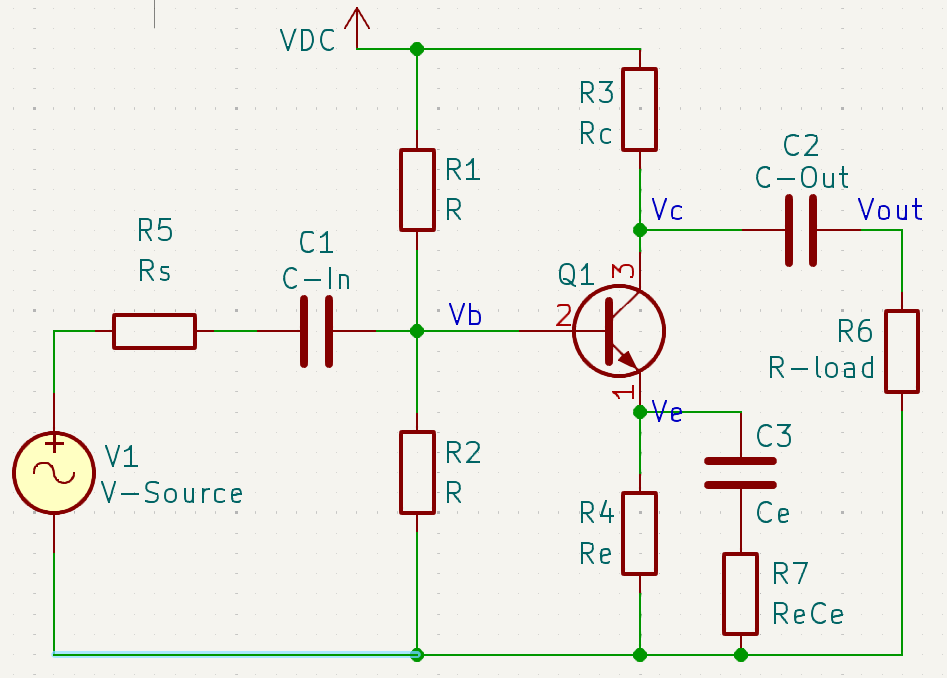
Amplifier Schematic
×

There are different ways to calculate an amplifier, depending on what you want to achieve.

Maybe you want to achieve a certain gain, as far as possible (classic mode). Or you have a low Vcc to respect (modern mode). Or you work with analog audio amps (symmetry mode).

Depending on what you want to achieve and the way of calculating it. Some fields might become dependent on others, or the other way around.

Your above choise makes some input fields available for manipulation, while hiding others.


🎯 1. Target Gain (Av) — "Classic mode" New English File Elementary Test Booklet Audio

You care about how much your amplifier multiplies the input signal.

Set desired voltage gain and Rc voltage drop. Best for learning and simple amplifiers.

You say: “I want a gain of 10.”
The app adjusts resistors to try and match that.
You must give Av and Vrc (the voltage dropped across Rc).

Best for common emitter amplifiers.

✅ Default choice for most beginners and educational use. : Discussing siblings, parents, and simple physical needs


⚡ 2. Target Emitter Voltage (Ve) — "Modern mode"

You care about setting a healthy DC bias point.

Prioritize stable biasing via Ve. Useful for low-voltage circuits or precision designs.

You say: “I want Ve = 0.5 V, to keep the transistor out of trouble.”
This makes sure your transistor stays in active mode.
Gain becomes whatever it turns out to be.

Ideal for common emitter amplifiers when the goal is to ensure proper biasing for low-voltage or precision circuits, and it’s also used in class AB amplifiers to prevent distortion The tracks are usually indexed clearly, making it

✅ Useful in low-voltage designs (e.g., 3.3V systems).


🧭 3. Target Collector Voltage (Vc) — "Symmetry mode"

You want to place the collector in the middle of the power rail.

Target Vc = Vcc/2 for maximum signal swing. Great for audio and analog signals.

You say: “Make Vc = Vcc/2” for maximum swing.
Useful for analog audio amps or symmetrical headroom.
Gain and Ve are outcomes.

Best for common collector amplifiers and class AB amplifiers.

✅ Best for signal integrity.

Booklet Audio: New English File Elementary Test

: Discussing siblings, parents, and simple physical needs like hunger or thirst.

If you cannot legally obtain the original audio, do not abandon listening assessment. You can create your own audio using modern tools:

Typically distributed as audio files (MP3 format in modern editions, or CDs in older printings), the audio is easy to integrate into a classroom setting via laptop, Bluetooth speaker, or language lab system. The tracks are usually indexed clearly, making it easy to find the correct test section during exam time.

The audio is a tapestry of mundane, wonderful life. Track 2 presents a man talking about his morning routine. “I wake up at seven o’clock. I have a shower. Then I eat toast.” The sentences are short, fortified with only the most essential verbs and nouns.

| Problem | Likely Cause | Solution | | :--- | :--- | :--- | | | Media player doesn’t support MP3 codec. | Use VLC Media Player (free) instead of Windows Media Player. | | Audio is too fast/slow | Sample rate mismatch (44.1kHz vs 48kHz). | Convert the MP3 to WAV using Audacity (free software). | | Missing Track 5 | Corrupted download from a file-sharing site. | Redownload only from Oxford Premium. | | Accent is unintelligible | Students are struggling with standard British English (RP). | Pause after the first play; explain key dialect differences. | | Cannot find File 7 Test | Mismatched edition (First vs Second vs Third). | Check your booklet cover for "Second Edition" – audio tracks are not cross-compatible. |